
The Factory-in-a box for Point of Care 3D Printing: Maximising Hospital Performance, Sustainability, and OR Efficiency
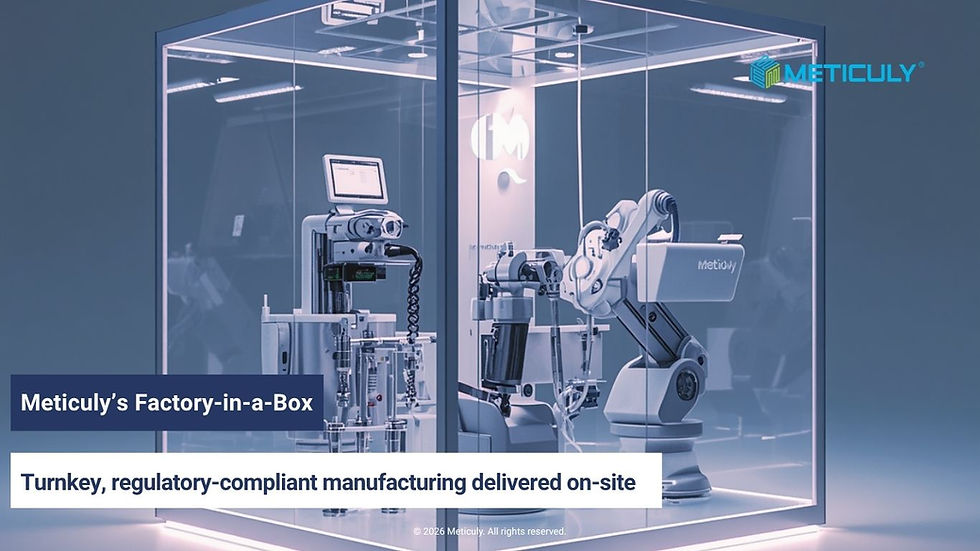
While the clinical advantages of personalised medicine for patients and surgeons are well-documented, the institutional benefits for healthcare facilities are equally profound. For hospital executives, chief medical officers, and clinical directors, the deployment of a point of care "Factory-in-a-Box" could represent a fundamental upgrade to operational workflow, supply chain design, and financial performance.
By moving manufacturing directly into the hospital ecosystem, healthcare facilities can unlock economic value, accelerate bed turnover, and advance institutional sustainability.
Operating Room Cost Saving
The operating room (OR) is both a hospital’s primary revenue driver and its most cost-intensive asset. Every minute saved in the theater directly translates to reduced overhead and increased surgical throughput [1,2].
A landmark economic evaluation by Ballard et al. [3] quantified the financial returns of integrating 3D printing directly into hospital workflows by measuring the reduction in total procedure times:
3D-Printed Anatomical Models: Saved an average of 62 minutes of surgical time per case, yielding a direct institutional cost savings of $3,720 per case.
3D-Printed Surgical Guides: Saved an average of 23 minutes of surgical time per case, translating to an immediate savings of $1,488 per case from reduced OR utilisation.
By eliminating intraoperative guesswork, manual hardware contouring, and trial-and-error sizing adjustments, hospitals can systematically lower anesthesia costs, minimise staff fatigue, and optimise the utilisation of their OR.
2. Elevating Clinical Case and Hospital Performance
Adopting an on-site manufacturing framework directly elevates an institution's clinical capabilities. This operational agility is best demonstrated in highly complex, precision-reliant fields like Oral and Maxillofacial Surgery and Orthognathic Surgery.
Case 1: Complex Mandibular Reconstruction [4]
In traditional workflows, a patient requiring mandibular reconstruction after tumor resection faces weeks of waiting while a customised plate is shipped from an overseas manufacturer. During this time, the patient occupies a hospital bed, and scheduling remains volatile.
The Point-of-Care Advantage: Utilising an on-site system like Factory-in-a-Box, the hospital can process the pre-operative CT scan, execute virtual planning, and 3D-print precision cutting guides and a titanium Patient-Specific Implant (PSI) on-site.
Institutional Impact: Reduced ischemia time for the microvascular flap, shortened total length of stay (LOS), and highly predictable aesthetic outcomes that minimise costly secondary revision surgeries.
Case 2: Accelerated Orthognathic Surgery Workflows
Corrective jaw surgeries require absolute occlusal precision. A retrospective study by Diment et al. [5] noted that point-of-care workflows drastically streamline bimaxillary advancements.
The Point-of-Care Advantage: Instead of relying on external laboratories to construct intermediate splints, the hospital prints custom surgical templates within 24 hours.
Institutional Impact: This rapid turnaround allows the hospital to transition elective cases into streamlined, highly efficient outpatient or short-stay procedures, maximising bed availability for critical care.
3. Supply Chain and Sustainability
Traditional orthopedic and reconstructive workflows place a heavy logistical and financial burden on hospital procurement teams. To accommodate unpredictable anatomical variations, hospitals must maintain massive, expensive inventories of generic implants [6].
Transitioning to an on-site, personalised model solves these long-standing logistical hurdles:
Zero Warehousing: Implants and guides are manufactured purely on-demand based on pre-operative CT data. This eliminates the carrying costs, sterilisation cycles, and physical footprint associated with maintaining bulk inventory.
Waste Reduction: Traditional subtractive manufacturing methods are inherently wasteful. Point of care additive manufacturing utilises precise powder quantities, creating a highly sustainable, near-zero-waste production cycle that aligns with modern hospital green initiatives.
Logistical Agility: On-site manufacturing eliminates the carbon footprint, shipping delays, and unpredictable customs friction inherent in international medical device transit.
4. Regulatory Frameworks and Medical Device Production Systems
Historically, executing an on-site manufacturing strategy required hospitals to navigate ambiguous liability and regulatory landscapes. However, international regulatory bodies have recently established formal guidelines to accommodate this paradigm shift [7,8].
The International Medical Device Regulators Forum (IMDRF) working group is actively finalising a global framework for Medical Device Production Systems (MDPS) [9]. This framework allows healthcare facilities to host validated, compliant manufacturing closed-loop systems safely within their own walls without taking on the regulatory burdens of a traditional commercial manufacturer.
Meticuly’s Factory-in-a-Box: The Turnkey Solution
By utilising Meticuly's proprietary, regulatory-compliant, AI design engines and 3D printing hardware, hospitals can produce fully approved titanium patient-specific implants right next to the operating theater—safely, predictably, and under strict FDA and international compliance protocols.
References:
[1] Riveros Perez, E., Kerko, R., Lever, N., White, A., Kahf, S., & Avella-Molano, B. (2022). Operating room relay strategy for turnover time improvement: a quality improvement project. BMJ Open Quality, 11(3), e001957.
[2] Childers, C. P., & Maggard-Gibbons, M. (2018). Understanding costs of care in the operating room. JAMA Surgery, 153(4), e176233.
[3] Ballard, D. H., Mills, P., Duszak, R., Woodard, P. K., & Smith, M. P. (2020). "Economic Evaluation of 3D Printing in Modern Medicine: A Systematic Review of Operating Room Time Savings and Cost-Effectiveness." Journal of the American College of Radiology, 17(9), 1120-1128.
[4] Katsura S, Morita Y, Kakimoto R, Miyamoto T, Kashima K, Ogasa E, Ueno Y, Tobe-Nishimoto A, Kishimoto S, Matsumiya-Matsumoto Y, Takeshita A, Matsunaga K, Uzawa N. Evaluating computer-assisted mandibular reconstruction: Outsourced vs. in-house approaches. Oncol Lett. 2025 Nov 25;31(2):48.
[5] Diment, L. E., Thompson, M. S., & Bergmann, J. H. (2017). "Clinical efficacy and effectiveness of 3D printing in orthopaedic surgery and traumatology: a systematic review." BMJ Open, 7(12), e016889.
[6] https://www.americanhhm.com/surgical-speciality/supply-chain-and-procurement-in-orthopedic-surgery
[8] Alzhrani RF, Fitaihi RA, Majrashi MA, Zhang Y, Maniruzzaman M. Toward a harmonized regulatory framework for 3D-printed pharmaceutical products: the role of critical feedstock materials and process parameters. Drug Deliv Transl Res. 2025 Dec;15(12):4501-4518. doi: 10.1007/s13346-025-01966-x. Epub 2025 Sep 16. Erratum in: Drug Deliv Transl Res. 2025 Dec;15(12):4819.
[9] International Medical Device Regulators Forum (IMDRF). (2024/2026). Medical Device Production Systems (MDPS): Regulatory Frameworks for Point-of-Care Manufacturing. Technical Report, IMDRF WG/MDPS.


Comments